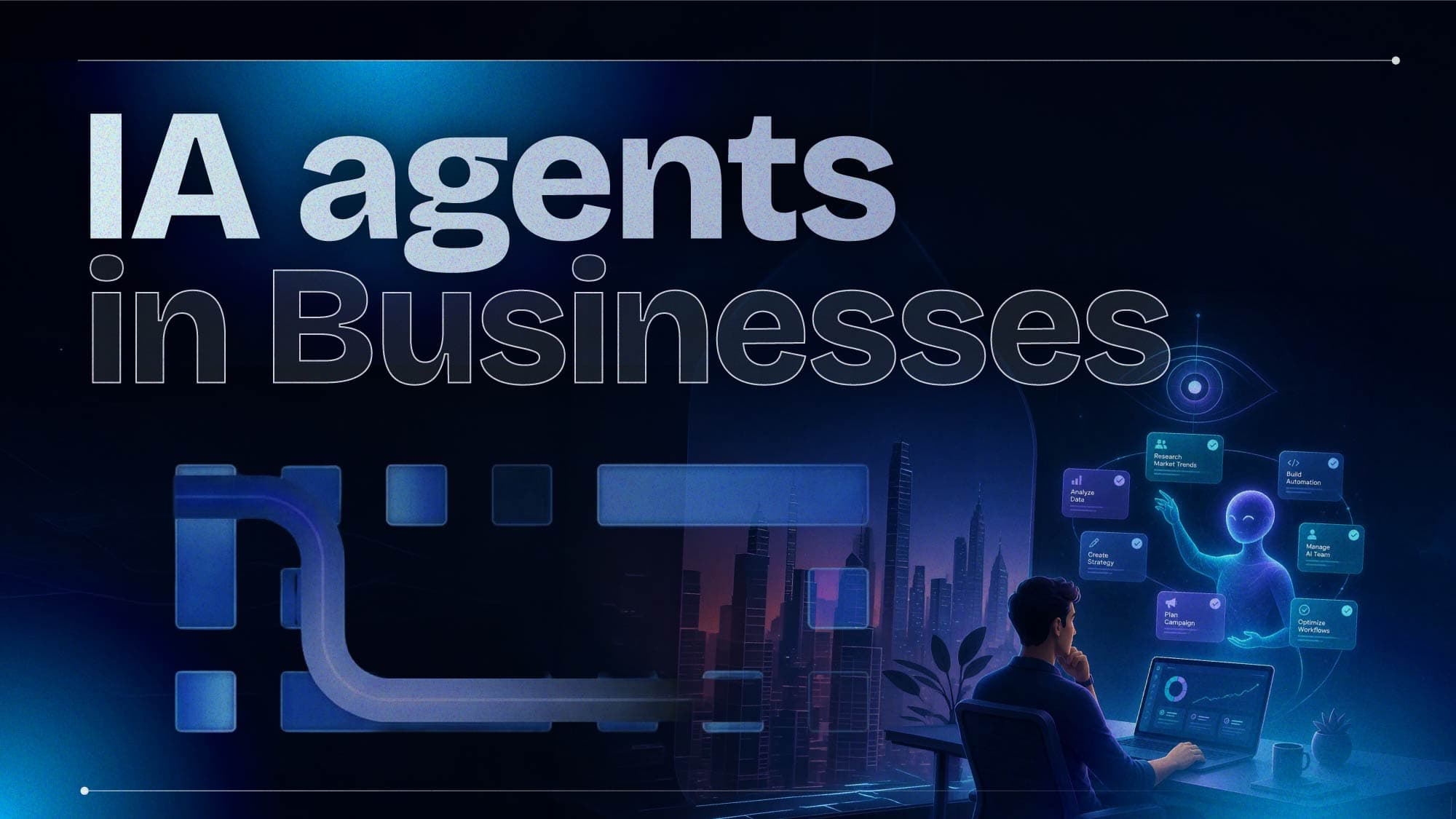
AI Agents for enterprises
July 1, 20268–10 mininnovationOver the past few years, conversations around artificial intelligence have been dominated by assistants capable of generating text, writing code, and answering questions in natural language. Today, however, the technology is evolving beyond content generation, introducing a new generation of applications that can not only produce responses but also execute tasks, interact with multiple systems, and make decisions as part of real business processes.
This is where AI Agents come in. Unlike a traditional AI assistant, an AI Agent can interpret objectives, retrieve information from multiple sources, use external tools, execute actions, and adapt to changing contexts to complete a task. In other words, it is no longer an isolated feature but an active participant in how an application operates.
This shift is driving a new era in software development. Organizations are no longer asking only how to incorporate artificial intelligence into their digital products. Instead, they are focused on building applications that can securely, reliably, and efficiently work alongside AI Agents while remaining aligned with business objectives.
Across industries such as banking, retail, insurance, healthcare, and technology, interest in AI Agents is growing rapidly because they create opportunities to automate complex workflows, reduce operational effort, and deliver better user experiences. However, deploying an AI Agent into production involves far more than integrating a large language model through an API. It requires rethinking application architecture, data strategy, security, and the way software interacts with the broader enterprise technology ecosystem.
Integrating an AI Agent involves much more than connecting a model
One of the most common misconceptions is that integrating an AI Agent is no different from connecting any other external service. In reality, integrating a language model through an API is often the easiest part of the project. The real challenge begins when the agent becomes part of actual business operations.
Imagine an insurance platform where an AI Agent supports the claims process. Providing an accurate recommendation requires much more than interpreting a user's request. The agent must retrieve policy information, verify coverage, review customer history, analyze supporting documents, apply internal business rules, and communicate with multiple enterprise systems before recommending the next step. The same applies to a financial platform, where an agent assists with loan origination, or a retail application that needs to access inventory levels, promotions, and product availability in real time.
These scenarios highlight an important reality: the AI model is only one component of the solution. The real engineering challenge lies in how the application organizes access to information, orchestrates system integrations, and defines which actions the agent is authorized to perform throughout the business workflow.
For this reason, many organizations are moving toward more loosely coupled architectures, where AI capabilities operate as independent services. This approach makes it easier to update models, introduce new AI Agents, or switch providers without disrupting the rest of the platform. More importantly, it enables organizations to maintain full control over their business logic instead of allowing critical decisions to depend directly on the behavior of the AI model.
Context is becoming more important than the model itself
During the early years of generative AI, much of the conversation centered on Prompt Engineering. As organizations began deploying AI Agents into production, however, it became clear that the real differentiator was not the prompt itself, but the quality of the context available to the model.
A new discipline is now emerging that is likely to shape the future of software development: Context Engineering. Rather than focusing on crafting better prompts, it is about designing the information environment an AI Agent needs to make accurate decisions that align with business objectives.
That context may include data from ERP systems, CRM platforms, business rules engines, e-commerce applications, customer records, technical documentation, and internal knowledge bases. It also encompasses permissions, security policies, and governance rules that determine which information an agent can access and which actions it is authorized to perform.
This fundamentally changes how enterprise applications are designed. Context is no longer just a collection of data. It becomes an architectural layer that must be continuously updated, governed, and available in real time. The richer and more reliable that context is, the more effectively an AI Agent can generate meaningful responses and execute business processes with accuracy.
It is no coincidence that many organizations are investing first in system integration, data quality, and application modernization before deploying AI Agents. In practice, an agent connected to trusted, well-governed information often delivers significantly more business value than a more advanced model operating on fragmented or outdated data.
AI Agents are changing how applications are monitored and evaluated
When a traditional application goes into production, engineering teams typically monitor metrics such as availability, response times, resource utilization, and system errors. Applications powered by AI Agents introduce an entirely new layer of complexity. It is no longer enough to know whether the application is running correctly. Organizations also need to understand how the agent is reasoning, how reliable its decisions are, and whether its outputs remain consistent over time. This has led to the emergence of new engineering practices such as LLM Observability and AI Evals. Organizations are beginning to measure metrics such as cost per interaction, token consumption, response quality, the percentage of tasks requiring human intervention, and how often an agent relies on external tools to complete a workflow.
These metrics make it possible to identify issues that traditional application monitoring would never detect while enabling teams to continuously improve an agent's performance after deployment. Artificial intelligence is no longer treated as a static software component. Instead, it becomes a continuously evolving service that requires ongoing monitoring, evaluation, and optimization.
The next challenge is connecting AI Agents to the enterprise ecosystem
AI Agents deliver the greatest value when they operate as part of the broader enterprise technology landscape rather than as standalone capabilities.
It is becoming increasingly common for an AI Agent to retrieve information from an ERP system, access customer data from a CRM, interact with e-commerce platforms, or execute actions within financial applications. Supporting these scenarios requires application architectures capable of integrating AI services without compromising security, performance, or platform stability.
Concepts such as the Model Context Protocol (MCP) and Tool Calling are becoming increasingly important because they aim to standardize how AI models interact with enterprise applications and external tools. Although these technologies are still evolving, they provide a clear indication of where software development is headed: toward intelligent applications where AI Agents are no longer simple assistants but active participants in enterprise business processes.
How to prepare for AI Agents
Rather than asking which AI model to use, organizations should first evaluate whether their technology platform is ready to support artificial intelligence in a sustainable way. That means assessing the current application architecture, the quality of business data, the level of integration across enterprise systems, and the security and governance mechanisms already in place.
The organizations seeing the strongest results are not trying to automate every process from day one. Instead, they begin by identifying specific use cases where an AI Agent can support repetitive tasks, accelerate analysis, or coordinate information across multiple applications. Those initial initiatives become the foundation for a technology platform that can scale AI adoption as business needs continue to evolve.
AI Agents don't replace strong architecture. They make it more important.
The adoption of AI Agents represents one of the most significant shifts software development has experienced in recent years. However, the success of these initiatives will not depend solely on the AI model an organization chooses to implement.
The real differentiator will be an organization's ability to build applications that can integrate new models, connect seamlessly with enterprise systems, maintain control over business data, and continue evolving without compromising operational stability.
The organizations that will realize the greatest value from AI Agents will not necessarily be the first to adopt them. They will be the ones with resilient architectures, well-defined business processes, and software platforms designed to adapt as AI technologies continue to evolve at an unprecedented pace.
In this new landscape, artificial intelligence is no longer an additional feature. It is becoming an integral part of modern software engineering.
Is your platform ready for AI agents?
At DreamCode, we help organizations develop enterprise applications, modernize existing systems, and integrate emerging technologies on software architectures built for continuous evolution.
If your organization is evaluating how to incorporate AI Agents into its applications, we can help you define the architecture, integrations, and technology strategy needed to implement these capabilities securely, at scale, and in alignment with your business objectives.